
Vendor risk assessment questionnaire
Forty security questions across ten areas to send to a supplier. Record their answers to get a weighted security score and a risk tier, and download the questionnaire or the results as CSV.
Governance
Certifications
Data protection
Access control
Security operations
Incident response
Business continuity
Subprocessors
Privacy
Financial and legal
- Security score
- –
- Answered
- 0 / 40
Score: Yes = full points, Partial = half, No = none, weighted 1 to 3 by importance. N/A is left out. 85% and above is low risk, 65% to 84% medium, below 65% high.
The vendor risk assessment process
- 01Inventory vendors
List every vendor, what data they handle and which processes depend on them.
- 02Tier them
Critical, high, medium or low, based on data sensitivity and business impact.
- 03Assess
Send the questionnaire and ask for evidence: SOC 2, ISO 27001, penetration test summary.
- 04Decide
Approve, approve with conditions, or reject. Record remaining risks in your risk register.
- 05Monitor
Reassess on schedule and after incidents or changes.
Vendor risk tiers
| Tier | Typical vendor | Assessment |
|---|---|---|
| Critical | Cloud hosting, core payment or health data processors | Full questionnaire, SOC 2 Type II or ISO 27001, yearly review |
| High | Tools holding customer or employee personal data | Full questionnaire and evidence, yearly review |
| Medium | Tools with limited internal data | Short questionnaire, review every two years |
| Low | No access to sensitive data or systems | Basic check at onboarding |
Vendor reviews linked to your risk register
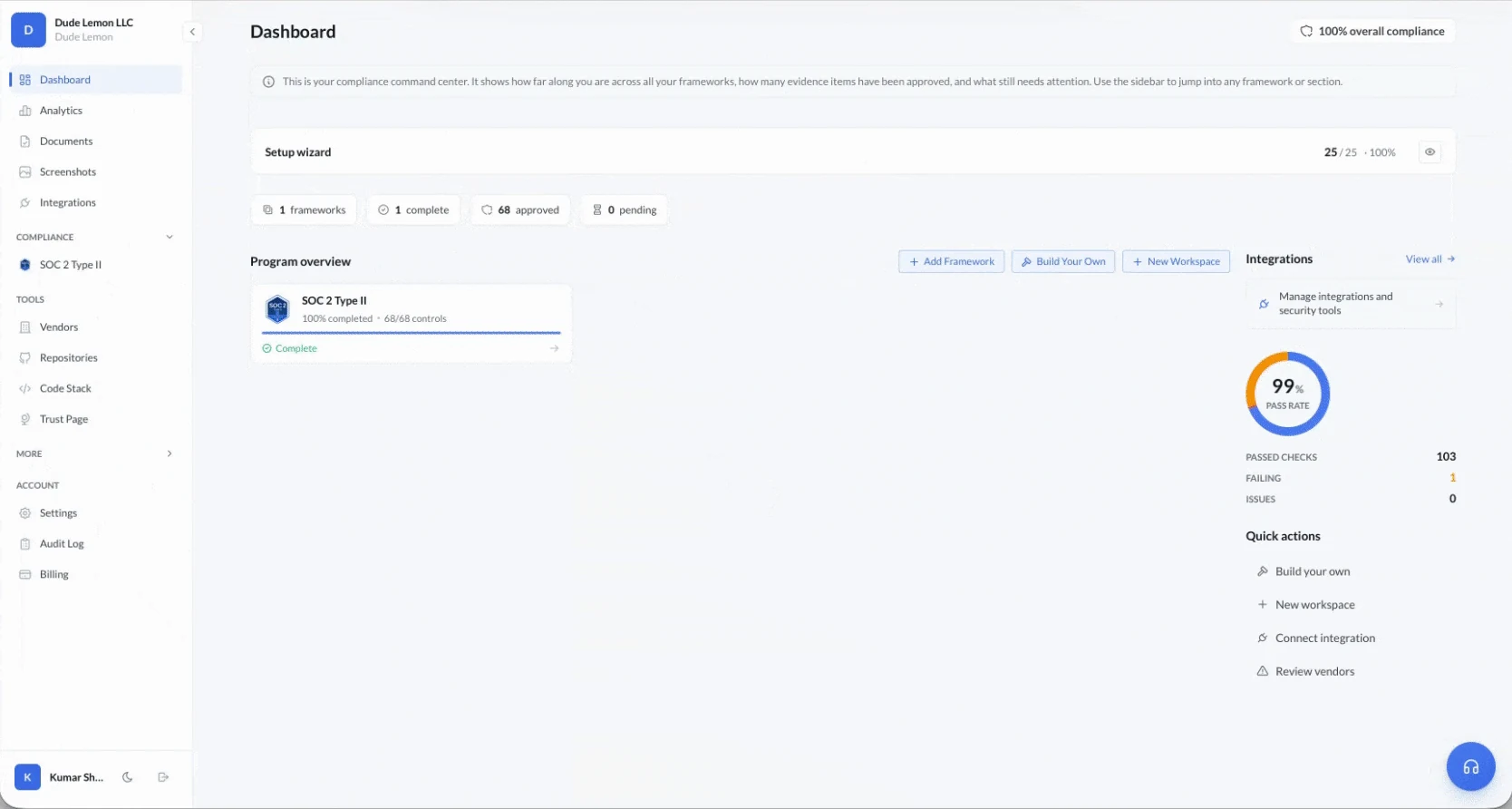
Evidr keeps your vendor inventory, runs vendor reviews and links each vendor risk to your risk register automatically, so third-party risk shows up in the same place as the rest of your risks when the auditor asks.
What is a vendor risk assessment?
A vendor risk assessment checks whether a supplier that handles your data or supports a critical process can be trusted to protect it. You ask security questions, review evidence such as a SOC 2 report, rate the risk and decide whether to use the vendor and on what terms.
What questions should a vendor risk assessment include?
Questions on security governance, certifications and audits, data protection and encryption, access control, security operations, incident response and breach notification, business continuity, subprocessors, privacy, and financial and legal standing. The questionnaire above covers all ten areas.
How do you score a vendor risk assessment?
Give each answer points (yes, partial or no), weight the questions by importance, and divide the points by the maximum possible. This tool rates 85% and above as low risk, 65% to 84% as medium and below 65% as high. Treat any "no" on a critical question as a follow-up item whatever the total.
How often should vendors be reassessed?
Critical and high-risk vendors at least once a year, others every two to three years, and any vendor after a breach, a major change in the service or a change of ownership.
Can a SOC 2 report replace a questionnaire?
Often it can replace most of it. A current SOC 2 Type II report from an independent auditor answers many security questions with tested evidence. Read the exceptions and the complementary user entity controls, and ask only what the report does not cover.
Is vendor risk management required for SOC 2 and ISO 27001?
Yes, in both. SOC 2 includes criteria on managing risks from vendors and business partners, and ISO 27001 Annex A includes controls on information security in supplier relationships.
More free tools
All free tools- Calculator5x5 risk matrixScore likelihood and impact, see the risk level and plot your risks on a heat map.Open
- TemplateRisk register templateA risk register with owners, scores, treatment and residual risk, exported to CSV.Open
- TemplateRisk assessment templateIdentify assets and threats, score each risk and record the controls that reduce it.Open
- TemplateIncident response plan templateFill in roles, contacts and steps for each phase, then download your plan.Open
- TemplateBusiness continuity plan templateCritical processes, recovery times, contacts and recovery steps in one plan.Open
- ChecklistHIPAA compliance checklistThe Privacy, Security and Breach Notification Rule requirements, as a checklist.Open