
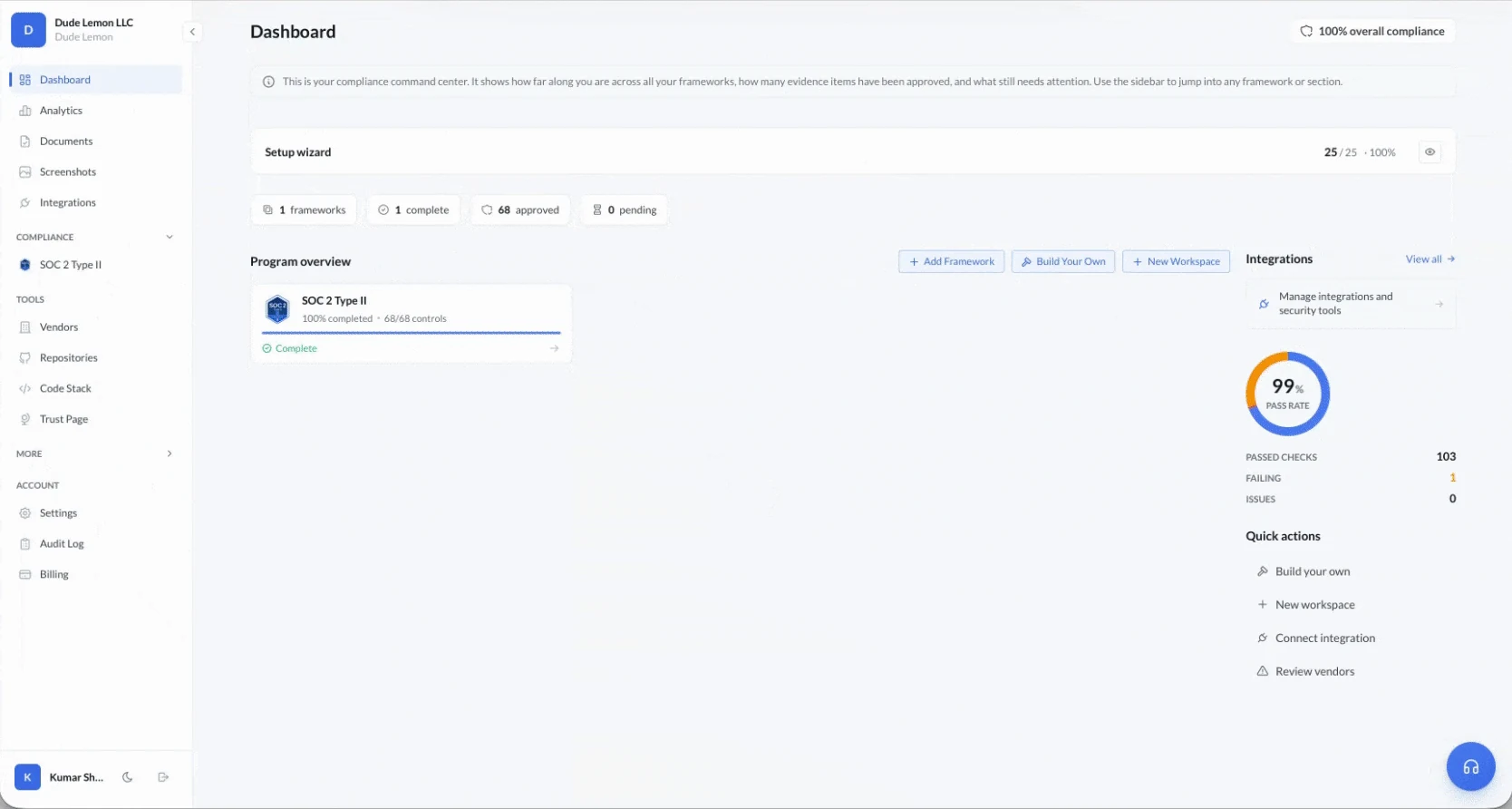
Vanta and Drata both support evidence collection, control mapping and auditor access. The useful comparison begins with your integrations, implementation workload, renewal terms and the work your team expects the platform to handle.
Use the evaluation questions and contract checks below during both product trials.
What they have in common
More than the comparison articles suggest. Both are mature, well-funded, widely deployed compliance automation platforms. Both do integration-based evidence collection, control mapping across frameworks, policy management, continuous monitoring and auditor access. Both have large integration catalogues and established auditor partner networks. Both are credible choices that will not get you fired.
For a standard SOC 2 or ISO 27001 programme you will struggle to find a decisive capability difference. The differences that matter are commercial and operational.
Neither publishes pricing
This is the most practically significant fact about evaluating either one, and it is rarely stated plainly. Both are quote-only: you enter a sales process to learn the number. Third-party procurement datasets show wide observed ranges for both, which is exactly what you would expect when price is negotiated per deal rather than published.
- 01You cannot shortlist on costComparing three vendors means three discovery calls, three demos and three negotiations before you know a single number.
- 02Your quote is not their priceIt depends on headcount, framework count, add-ons, timing in their quarter and how well you negotiate.
- 03Add-ons are where budgets breakTrust centre, vendor risk and questionnaire automation are frequently priced separately from the core platform.
- 04Renewal is the real numberThe first-year discount is the easy win. The uplift at renewal is the one that costs you, and it is negotiable only at signature.
Vanta vs Drata plan by plan
Neither vendor prints a price, but both publish what each plan includes. This is what the two plan pages listed when read on 19 November 2026. Plan contents change, so confirm the current page and your quote.
| Vanta | Drata | |
|---|---|---|
| Entry plan | Essentials: one compliance framework, automated evidence collection, auditor API and a Trust Center | Foundation: up to 50 FTEs and one pre-mapped framework, limited to SOC 2, ISO 27001, Cyber Essentials, HIPAA or GDPR |
| Adding frameworks | Plus, Professional and Enterprise sit above Essentials; the page does not list their framework counts | Advanced allows any available framework; additional frameworks are listed as an add-on |
| Trust centre | Trust Center on Essentials, Advanced Trust Center on Professional | Trust Center Standard on Foundation, plus separate Trust Center plans (Foundation, Advanced, Enterprise) |
| Security questionnaires | AI-powered questionnaire automation: 25 a year on Plus, 144 a year on Professional | AI Questionnaire Assistance Standard on Foundation |
| Top tier | Enterprise: a customisable package for advanced GRC needs | Enterprise: adds Risk Management Pro, Compliance as Code Pro and User Access Review |
| Price | Personalised pricing after a demo | Plans start from a demo request; no prices shown |
Sources: vanta.com/pricing and drata.com/plans, read 19 November 2026.
Vanta vs Drata for startups and for enterprise
- 01Seed or early stage, one frameworkBoth entry plans cover one framework. Drata Foundation caps headcount at 50 FTEs and limits the framework to five named standards, so check both limits against your hiring plan and your first customer’s request.
- 02A second framework within a yearAsk each vendor for the price of the second framework before you sign. Drata lists additional frameworks as an add-on on every plan, and Advanced opens the choice to any available framework. Vanta’s page does not list framework counts above Essentials, so they come with the quote.
- 03Security questionnaires at volumeVanta states a yearly questionnaire allowance per tier. Count last year’s questionnaires before choosing a tier on either platform.
- 04Enterprise or multi-entityCompare the top tiers on risk management, access reviews and workspaces. Drata lists workspaces and custom frameworks as add-ons; Vanta describes Enterprise as a customisable package.
Whichever stage you are at, run the same trial on both: your own integrations, your own evidence and the auditor view. Plan names tell you what is included; the trial tells you how much work is left for your team.
The evaluation scorecard
Run both through these during the trial. The answers differ by company and by quarter, which is exactly why a static feature table is not much use.
Score both vendors on every line. Anything you cannot verify yourself during a trial should be treated as unproven, not as true.
Product, verified yourself
0/6Commercial, in writing
0/6Evidence from other people
0/3Switching between them
It happens regularly at renewal and it is less dramatic than vendors imply, but it is not free.
| What moves | Effort | Note |
|---|---|---|
| Integrations | Low to moderate | Reconnect each one. An afternoon for a small stack, longer if you have many accounts per platform |
| Policies | Low | Usually exportable as documents, then re-uploaded |
| Historical evidence | Moderate to high | This is the real cost. Ask both vendors what export produces before you sign either |
| Control mappings | Moderate | Rarely portable between platforms; usually rebuilt |
| Audit trail | Varies | Often exportable but not importable, so you keep an archive of the old one |
| Auditor familiarity | Low | They adapt quickly, but tell them before fieldwork, not during |
The practical advice: switch between observation windows, never during one. Changing evidence platforms mid-window means your auditor samples across two systems and both of you will regret it.
When a third option is worth considering
Both Vanta and Drata are built for, and priced for, companies that have decided compliance is a funded programme. That is the right answer for many companies. It is not the right answer for all of them.
- You want a published price before you talk to anyone.
- You expect to run several frameworks and do not want per-framework charges.
- You want to see the product working on your own stack before committing to an annual contract.
- Nobody at your company works on compliance full time and you need the tool to do more of the reading.
- Your total compliance budget is a meaningful fraction of the contract you are trying to unblock.
Evidr pricing and evidence workflow
Evidr publishes its pricing and supports evidence collection across fourteen frameworks.
| EvidrThis is us | Vanta | Drata | |
|---|---|---|---|
| Pricing published | |||
| Frameworks in the price | All 14 | Tiered / add-on | Tiered / add-on |
| Cost to add a framework | $0 | Quote | Quote |
| Penetration test run in-houseBy the vendor own team, not referred | |||
| Self-serve start, no demo required | |||
| Integration catalogue size | 22 plus device agent | Largest | Very large |
Evidr publishes its pricing and framework coverage, and its product pages describe its evidence workflow and in-house penetration testing. Vanta and Drata are established platforms with their own integration catalogues. Compare the specific connectors, review workflow, evidence export and procurement requirements your team needs, using a demonstration rather than brand recognition alone.