
Compliance management software should make the next security task clear: which control needs attention, who owns it, what record proves it ran and when someone reviewed that record. That matters when your team starts with SOC 2 and a customer then asks about ISO 27001 or HIPAA. The work expands quickly, while the people doing it often stay the same.
Evidr brings the control register, evidence collection, monitoring, policy work and auditor access into a single programme. Begin with the framework your buyer needs, connect the systems that hold the underlying records and assign real owners. The result is a working calendar your team can use each week.
| The work | Record to keep | Next person who needs it |
|---|---|---|
| Define a control | Owner, scope, frequency and framework mapping | Security or compliance lead |
| Collect evidence | Original file or read-only system result with date and source | Control reviewer |
| Review an exception | Decision, action, owner and closure record | Management and examiner |
| Prepare a request | Approved evidence and the period it covers | CPA firm or certification auditor |
The useful unit is the control and its operating history, with each handoff visible.
What does compliance management software organise?
A framework names the requirement. Your organisation names the control that meets it. Software should keep that link readable alongside the owner, operating frequency, evidence and review. For SOC 2, the AICPA Trust Services Criteria describe the criteria used in the examination. ISO/IEC 27001:2022 defines requirements for an information security management system. HIPAA Security Rule section 164.308(a)(1) calls for a security management process, including risk analysis and regular review of system activity.
Those sources have different language and scopes. The same access review might support more than one programme when the systems, period and decision are relevant to each. Evidr maps controls and evidence across active frameworks so a team can work from one reviewed source record. The mapping should remain visible to the owner who knows what the control actually does.
Start with a current control. Name the application or infrastructure in scope, the people who can administer it, the review frequency and the document or log generated each time. That gives the software a useful record to organise. An empty green status without an operating record will not answer a buyer or an examiner.
How do you keep evidence current across frameworks?
Evidence arrives from several places: identity systems, cloud configuration, tickets, policies and management decisions. Evidr supports uploads, read-only integrations, control mapping, AI-assisted review and version history. Its monitoring can flag ageing evidence and direct an alert to the person responsible. This turns collection into a repeatable routine rather than a large search when a deadline appears.
- SourceKeep where the record came fromRetain the original system or file reference, collection time and relevant version.
- OwnerAssign the person who can explain itThe owner knows whether the activity happened and can respond when an item is missing.
- ReviewRecord a dated decisionA reviewer accepts the evidence, requests a correction or records an exception.
- PeriodShow when the control operatedKeep each expected occurrence visible across the period a customer or examiner asks about.
For example, a monthly access review needs a record for each scheduled month. A fresh export of user accounts is useful input, while the dated review decision shows what management did with that list. If one month is missing, the register should identify the gap and its owner. The team can then address it openly and keep the later improvement in the same history.
Which workflow should a small team set up first?
Choose the framework behind an active customer request. Pick a small set of recurring controls that already have owners: access review, change approval, vulnerability handling and vendor review. Put each control on a calendar and connect one source at a time. The first week is successful when the owner can find the next due item and the reviewer can open its source.
- Define the service or information boundary and the framework the buyer requested. Record the specific systems and people in scope.
- Assign an owner and reviewer to each recurring control. Write down its cadence before collecting files.
- Connect the system of record or upload the original evidence. Preserve the source date and the decision date separately.
- Review one complete occurrence and one known exception. Route the exception to a named person with a follow-up date.
- Open the resulting record from a reviewer account and export the approved material for the relevant period.
Evidr’s evidence collection, continuous monitoring and scoped auditor access support that sequence. The product pages show the screens behind each step. A founder can start with the core register and add integrations where they replace repeated manual work. A security lead can see which owners need attention before the next customer review.
How do SOC 2, ISO 27001 and HIPAA share work?
Common security activities often appear in each programme, but the required records and scope differ. SOC 2 CC6.1 addresses logical access security within the selected system. ISO/IEC 27001:2022 uses an information security management system with risk treatment and a Statement of Applicability. HIPAA section 164.308(a)(1)(ii)(A) requires an accurate and thorough risk analysis for electronic protected health information. Preserve the framework-specific question beside the shared control so the right reviewer can inspect it.
| Shared activity | Possible programme use | What to retain |
|---|---|---|
| Access review | SOC 2 CC6.1 and selected ISO 27001 controls | Population, reviewer decision, exceptions and dates |
| Risk assessment | SOC 2 CC3, ISO 27001 risk process and HIPAA 164.308(a)(1) | Scope, method, findings, decisions and treatment |
| Vendor review | SOC 2 CC9 and applicable ISO 27001 supplier controls | Vendor scope, review, approval and follow-up |
A cross-framework link should preserve each requirement and the evidence that supports it.
Evidr supports multiple framework views from the same evidence repository. This is most useful when your team can reuse a reviewed source without losing the reason it was collected. The framework page gives a starting point for each requirement. Build the shared controls around your actual systems and commitments.
What should you see on the dashboard each week?
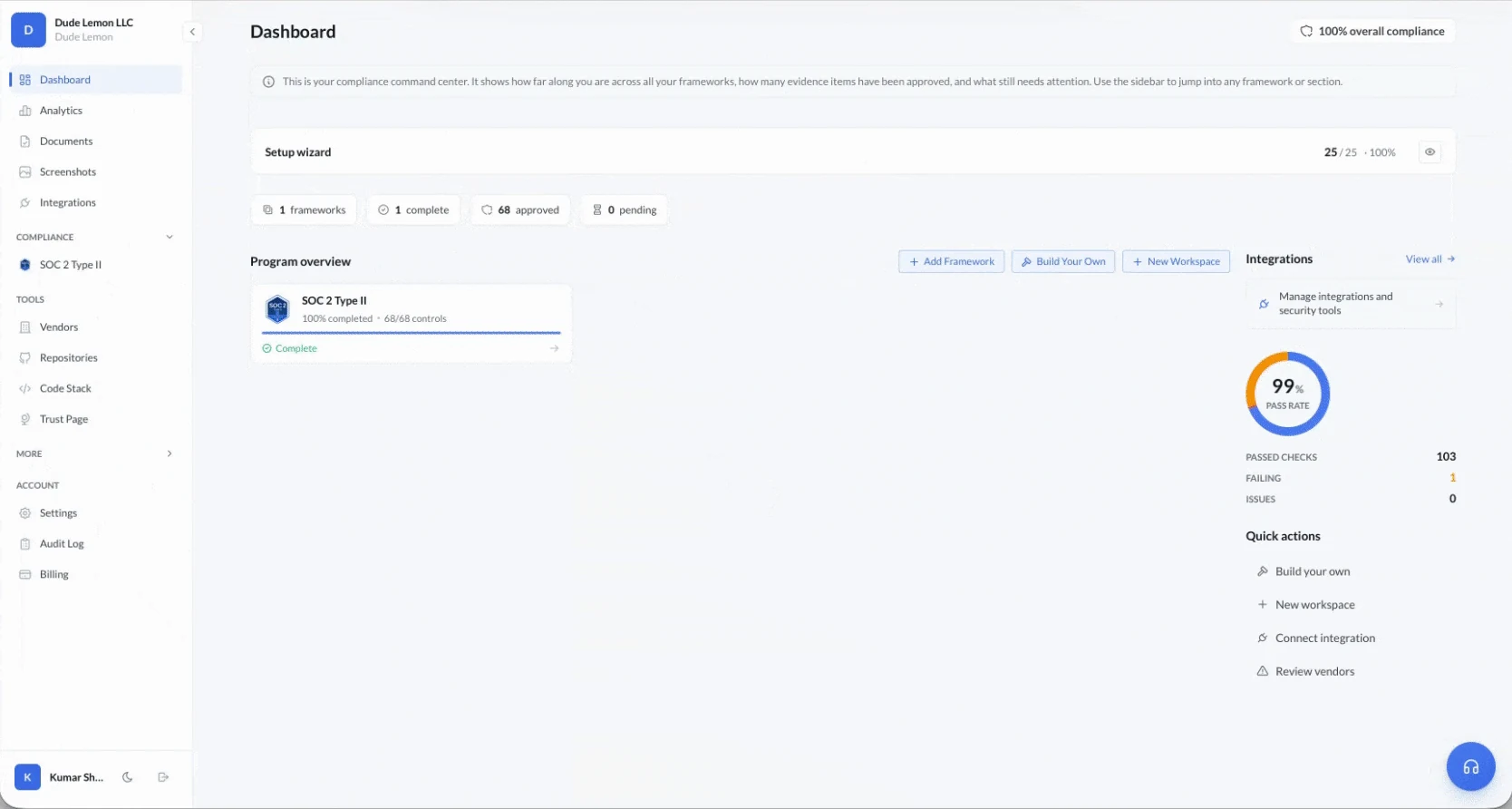
The weekly view should answer four questions: what is due, what is missing, which review is waiting, and what changed in the connected systems. Evidr’s continuous monitoring tracks evidence age and cloud and device checks where those capabilities are enabled. Its gap view prioritises missing or failing items. An owner can open the underlying record and act before the next request arrives.
- Due controls with a named owner and expected record.
- Evidence awaiting review, with its original source and date.
- Exceptions that need a decision or a corrective action.
- Expired or disconnected sources that need a new collection.
Make a short weekly meeting out of this view. Owners can confirm what operated, reviewers can decide what the evidence shows, and the programme lead can see whether a customer request has enough approved material. The audit trail keeps the actions readable after the meeting ends.
How do you prepare an auditor or customer handoff?
A customer may need an approved policy or an existing report. An independent examiner may request a population and selected records for a defined period. Evidr’s read-only auditor portal gives scoped access to approved material and records activity. Prepare the request by choosing the relevant controls, period and approved evidence, then confirm what the recipient can see.
A SOC 2 report is issued by an independent CPA firm, and an ISO 27001 certificate comes from a certification body after its process. Evidr helps your team organise the records they examine. That separation keeps the handoff clear: your organisation operates and explains its controls, while the independent party performs its work.
Open an export outside the platform before a deadline. Check the control name, source, dates, approvals and exceptions. A buyer or examiner should be able to follow the record without asking your team to reconstruct it from several inboxes. The product’s evidence and auditor pages show the available workflow.
When is it time to choose a platform?
The signal is repeated coordination work. Several frameworks ask for overlapping evidence. Different owners have files in different systems. Reviews slip because nobody can see the due date. A customer asks for material and the team spends days finding the current version. At that point, a shared control and evidence system gives the work a home.
Bring your actual control register to the product tour. Enter one recurring control, collect a record, route a review, handle an exception and open the scoped reviewer view. Compare the current plan on Evidr’s pricing page with the people, integrations and framework coverage your programme needs. Start with the path that solves the next real request, then expand the routine as your business grows.