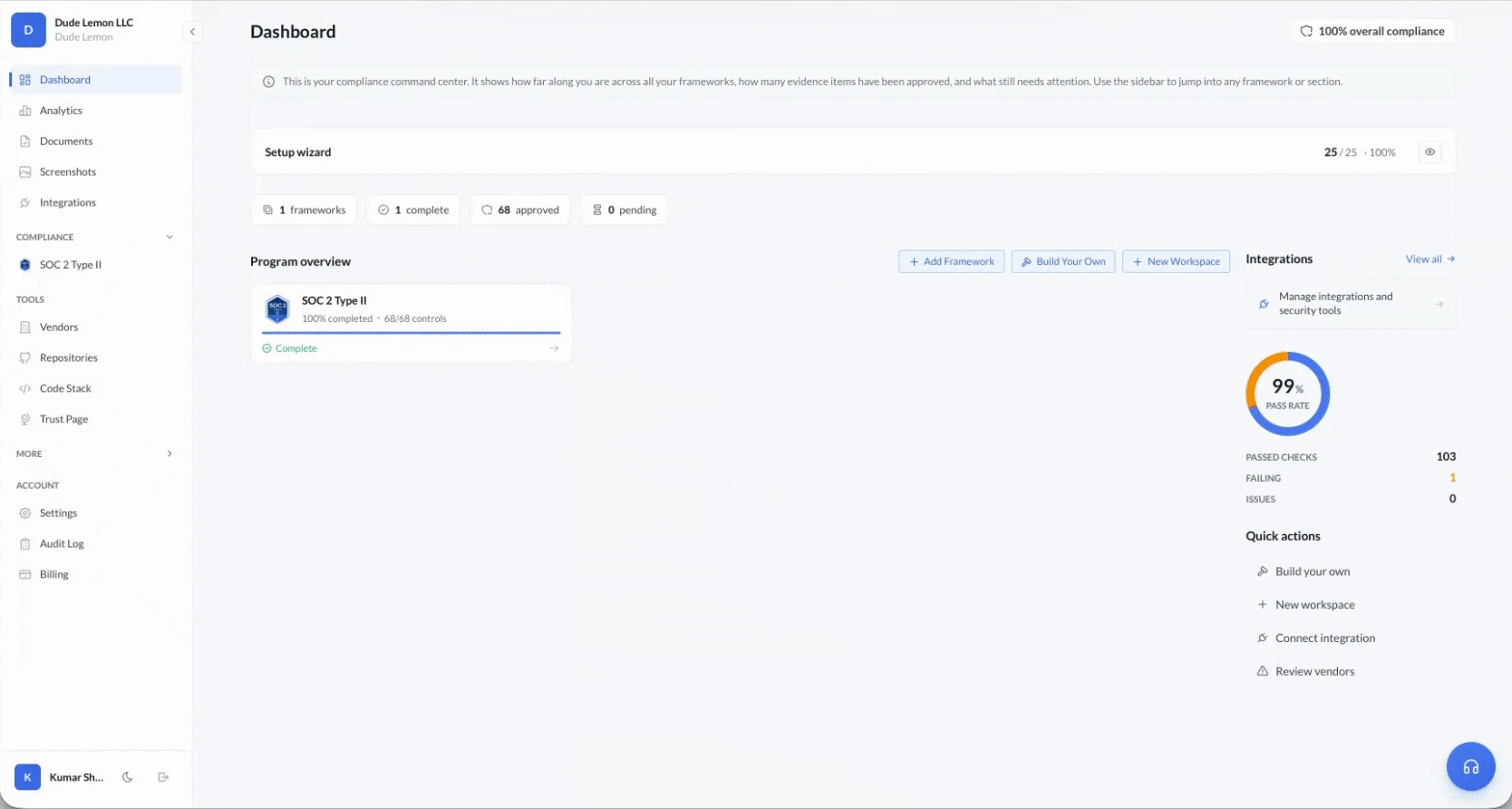
NIST 800-171 Compliance

Protect CUI and achieve NIST 800-171 compliance faster

Evidr automates control mapping, SPRS score calculation, and System Security Plan generation for defense contractors. Meet DFARS requirements and prepare for CMMC with AI-powered compliance automation.

Built by the same team that builds platforms for

GoogleAWSBMWPhilips
110
Security controls
14
Control families
8-12
Weeks to compliance
SPRS
Score tracking

14 Control Families, 110 Requirements

NIST 800-171 organizes security requirements into 14 families derived from NIST 800-53. Evidr maps your existing controls across all families and calculates your SPRS score in real-time.

3.1 Access Control22 controls
3.2 Awareness and Training3 controls
3.3 Audit and Accountability9 controls
3.4 Configuration Management9 controls
3.5 Identification and Authentication11 controls
3.6 Incident Response3 controls
+ 8 more control families covering maintenance, media protection, personnel security, physical protection, risk assessment, security assessment, and system integrity.
NIST 800-171 AssessmentScore: 87/110
Access Control - 20/22 controls
Audit & Accountability - 9/9
ID & Authentication - 9/11
System Protection - 13/16
SPRS Score87 / 110

Everything you need for NIST 800-171 compliance

From CUI boundary documentation to SPRS submission, Evidr automates defense contractor compliance so you can focus on your mission.

110 Control Mapping

Evidr automatically maps your existing security controls to all 110 NIST 800-171 requirements across 14 control families. See exactly where you stand.

SPRS Score Calculator

Real-time SPRS score calculation based on your implemented controls. Track your score as you remediate gaps and prepare for DoD submission.

CUI Boundary Documentation

Document your Controlled Unclassified Information boundary, data flows, and system interconnections. Essential for compliance scoping.

System Security Plan Generation

Generate NIST 800-171 compliant SSP documentation with AI assistance. Control implementation descriptions, policies, and procedures.

POA&M Tracking

Manage Plans of Action and Milestones for controls not yet fully implemented. Track remediation progress and milestone deadlines.

CMMC 2.0 Readiness

NIST 800-171 forms the foundation of CMMC Level 2. Compliance positions you for future CMMC certification requirements.

Manual vs. automated NIST 800-171 compliance

Without Evidr
6-12 months to compliance
Track 110 controls in spreadsheets
Manually calculate SPRS score
Write 200+ page SSP from scratch
No visibility into POA&M progress
Separate effort for CMMC preparation
With Evidr
8-12 weeks to compliance
Automated control mapping and tracking
Real-time SPRS score calculation
AI-generated SSP documentation
POA&M tracking with milestone alerts
Same controls map to CMMC Level 2

NIST 800-171 compliance in 12 weeks

Follow our proven process to protect CUI and meet DFARS requirements faster than traditional approaches.

1

CUI Scoping & Boundary Definition

Identify where CUI is stored, processed, and transmitted. Document your system boundary and data flows. This scoping determines which controls apply.

Week 1-2
2

Gap Assessment

Evidr maps your existing controls to NIST 800-171 requirements. Generate initial SPRS score and identify control gaps across all 14 families.

Week 2-4
3

Control Implementation

Address control gaps with guided remediation workflows. Implement technical controls, generate policies, and document procedures.

Week 4-10
4

SSP & POA&M Documentation

Generate System Security Plan documenting all control implementations. Create POA&Ms for any controls not fully implemented with remediation timelines.

Week 10-12
5

SPRS Submission

Calculate final SPRS score based on implemented controls. Submit assessment results to SPRS database. Prepare for potential DCMA audits.

Week 12+

Frequently asked questions about NIST 800-171

What is NIST 800-171?

NIST Special Publication 800-171 "Protecting Controlled Unclassified Information in Nonfederal Systems and Organizations" defines security requirements for contractors and other organizations that handle Controlled Unclassified Information (CUI). It contains 110 security controls organized into 14 families, derived from NIST 800-53 but tailored for non-federal systems.

Who needs to comply with NIST 800-171?

Any organization that handles Controlled Unclassified Information (CUI) as part of a federal contract must comply with NIST 800-171. This primarily affects defense contractors, subcontractors, and suppliers in the Defense Industrial Base (DIB) subject to DFARS clause 252.204-7012. The requirement flows down to all tiers of the supply chain that handle CUI.

What is Controlled Unclassified Information (CUI)?

CUI is information that requires safeguarding or dissemination controls pursuant to federal law, regulations, or government-wide policies, but is not classified. In defense contracting, CUI often includes technical data, engineering drawings, manufacturing specifications, and other sensitive but unclassified information marked as CUI or with legacy markings like FOUO, SBU, or LES.

What is SPRS and how does it work?

SPRS (Supplier Performance Risk System) is the DoD database where contractors must submit their NIST 800-171 self-assessment scores. Contractors calculate their score by starting with 110 points (full compliance) and subtracting weighted values for each unimplemented control. Scores must be submitted before contract award and updated when compliance status changes.

How is the SPRS score calculated?

SPRS scores start at 110 (fully compliant) and subtract points for each unimplemented control. Controls are weighted by risk: 5 points (highest risk), 3 points (medium), or 1 point (lower risk). For example, not implementing multi-factor authentication (5 points) has greater impact than missing a training procedure (1 point). The minimum possible score is -203.

What is the difference between NIST 800-171 and CMMC?

NIST 800-171 is a set of security requirements that contractors self-attest to meeting. CMMC (Cybersecurity Maturity Model Certification) adds third-party assessment and certification. CMMC Level 2 is directly based on NIST 800-171's 110 controls. Organizations compliant with 800-171 are positioned for CMMC Level 2 when certification becomes required.

What is a System Security Plan (SSP)?

The SSP is a required document that describes your system boundary, how CUI is protected, and how each NIST 800-171 control is implemented. It serves as the primary documentation for compliance. Evidr generates SSPs automatically based on your control implementations, including boundary diagrams, control descriptions, and interconnection details.

What is a POA&M?

A Plan of Action and Milestones (POA&M) documents security weaknesses (controls not yet fully implemented), planned remediation activities, and target completion dates. POA&Ms are required when you cannot fully implement all 110 controls. They must include specific milestones, resources, and completion dates for each identified gap.

Often paired with NIST 800-171

Evidr supports 12+ compliance frameworks with shared evidence and unified control mapping.

Ready to achieve NIST 800-171 compliance?

Schedule a demo with our compliance team. We will walk you through automated control mapping, SPRS score calculation, and SSP generation for defense contractors.